Vadzo Imaging Positions Innova-234MGS 2MP Onsemi AR0234 Monochrome Gigabit Ethernet Camera for Industrial Inspection
The Innova-234MGS is a 2MP Monochrome Global Shutter Gigabit Ethernet Camera based on the onsemi AR0234 sensor,
Press Release Disclaimer: This is a press release distributed through the XPR Media network. It has not been independently verified by our newsroom.


The Innova-234MGS is a 2MP Monochrome Global Shutter Gigabit Ethernet Camera based on the onsemi AR0234 sensor, designed for industrial inspection, machine vision, and factory automation applications. Its global shutter architecture enables accurate image capture of moving objects without the motion distortion associated with rolling shutter cameras, while the monochrome sensor provides high-contrast imaging for defect detection, dimensional inspection, and code reading. Gigabit Ethernet connectivity with PoE enables flexible deployment over a single network cable, while ONVIF support facilitates integration with compatible video management and industrial imaging systems.
FORT WORTH, TX / ACCESS Newswire / September 22, 2026 / Vadzo Imaging, a provider of embedded vision camera products for OEMs and system integrators, today positions the Innova-234MGS AR0234 Monochrome GigE Camera, a 2MP monochrome global shutter gigabit ethernet camera built on the Onsemi AR0234 sensor for industrial inspection applications. Part of Vadzo’s GigE Vision camera portfolio, the Innova-234MGS pairs the AR0234’s global shutter architecture with a monochrome pixel array and native GigE Vision connectivity, giving inspection system integrators a camera that captures moving parts without motion distortion, delivers the contrast defect detection algorithms depend on, and runs over a single Power over Ethernet cable across the distances a production line actually spans. With this positioning, Vadzo delivers an AR0234 Mono Global Shutter Camera that integrates directly with the GigE Vision-compliant machine vision software already common on factory floors, giving quality engineers, machine vision integrators, and industrial automation OEMs a camera platform ready for direct integration into inspection stations without a proprietary capture card or short-range cabling constraint.
Technical Problem Definition
Industrial inspection camera products face three problems at once, and solving only one or two still leaves a system that fails in production. The first is motion. Parts on a conveyor or assembly line move continuously past the inspection point, and a rolling shutter sensor reads a frame row by row over a measurable interval, which means a moving part shifts position during that readout window and the resulting image shows geometric skew or smear rather than the part’s true shape. An automated inspection algorithm measuring a dimension or comparing an edge against a reference template cannot distinguish a genuine defect from a distortion artifact introduced by the shutter itself, which produces both false rejects on good parts and missed detections on parts with real defects whose distortion happens to mask them. The second problem is contrast. Many inspection tasks, including surface defect detection, edge and dimensional measurement, and code reading, depend entirely on luminance contrast and gain nothing from color information, yet a color sensor’s Bayer filter array absorbs a meaningful share of incident light before it reaches the photodiode, reducing the contrast and effective resolution available for exactly the measurement the inspection system needs to make. The third problem is physical placement. Inspection stations sit at fixed points along a line that can run tens of meters, and the camera at each station needs both power and a data connection back to a central control cabinet or industrial PC. A camera interface limited to a few meters of cable run forces either a compute module at every station or a proprietary extension scheme, and a camera that does not speak a standard machine vision protocol forces an integrator to either write custom capture software or discard the GigE Vision-compliant tools and libraries a manufacturing engineering team may already depend on for other lines in the same facility. A Global Shutter Gigabit Ethernet Camera that solves the cabling problem without also solving the motion and contrast problems still leaves an inspection station that produces unreliable measurements, and a High Speed GS Ethernet Camera validated only on a lab bench provides no assurance that it will hold up at actual conveyor speeds once installed. OEMs specifying a camera for a new inspection line often discover these gaps only after the line is already running, when a distorted frame at speed or a cabling limitation at an awkward station position forces a redesign that a properly specified camera would have avoided from the start.
Engineering Explanation
The Innova-234MGS addresses all three problems through the combination of its sensor architecture and its interface choice. The Onsemi AR0234 is a 2MP (1920 x 1200) CMOS sensor with a 1/2.6 inch optical format and a 3.0 micron pixel pitch, built with a global shutter that exposes every pixel simultaneously rather than scanning rows sequentially. This eliminates the row-by-row timing difference that produces motion skew, so a part moving through the inspection point at typical conveyor speeds is captured with its true geometry intact regardless of how fast it is traveling relative to the camera’s frame rate. The Innova-234MGS uses the monochrome variant of the AR0234 die, in which the color filter layer is omitted entirely, meaning every pixel site contributes directly to the luminance signal rather than a fraction surviving color interpolation. This delivers a meaningfully sharper, higher-contrast image for a Global Shutter Inspection Sensor role than the color variant of the same sensor would provide at equivalent illumination, which matters directly for edge detection, dimensional measurement, and code reading algorithms that operate purely on luminance contrast. On the interface side, the camera implements native GigE Vision connectivity with Power over Ethernet, so a single Cat5e or Cat6 cable carries both gigabit data and camera power to an inspection station positioned anywhere along a production line within the cable’s supported distance, without a media converter or a compute module co-located at the camera. GigE Vision is an established, widely adopted machine vision interface standard, so a GS Ethernet Vision Sensor of this kind integrates with third-party GigE Vision compliant software already running elsewhere in a facility, rather than requiring a proprietary capture card or driver stack specific to one vendor. This combination makes a Mono GS Inspection Module genuinely suited to the compound requirement industrial inspection actually presents, rather than solving the motion problem or the cabling problem in isolation, and validates the camera as a complete GigE Vision GS Inspection solution rather than a sensor and interface paired together without end-to-end confirmation. The camera is rated across a -20 degree C to 60 degree C operating range, matching the environmental conditions typical of indoor factory floors and enclosed production line environments. Vadzo validates motion integrity under actual line speed conditions rather than a static bench test alone, since a global shutter sensor’s timing advantage only matters if the complete camera and lens assembly holds that advantage through the vibration, thermal drift, and continuous duty cycle a real production line imposes over a full shift.
Product Overview
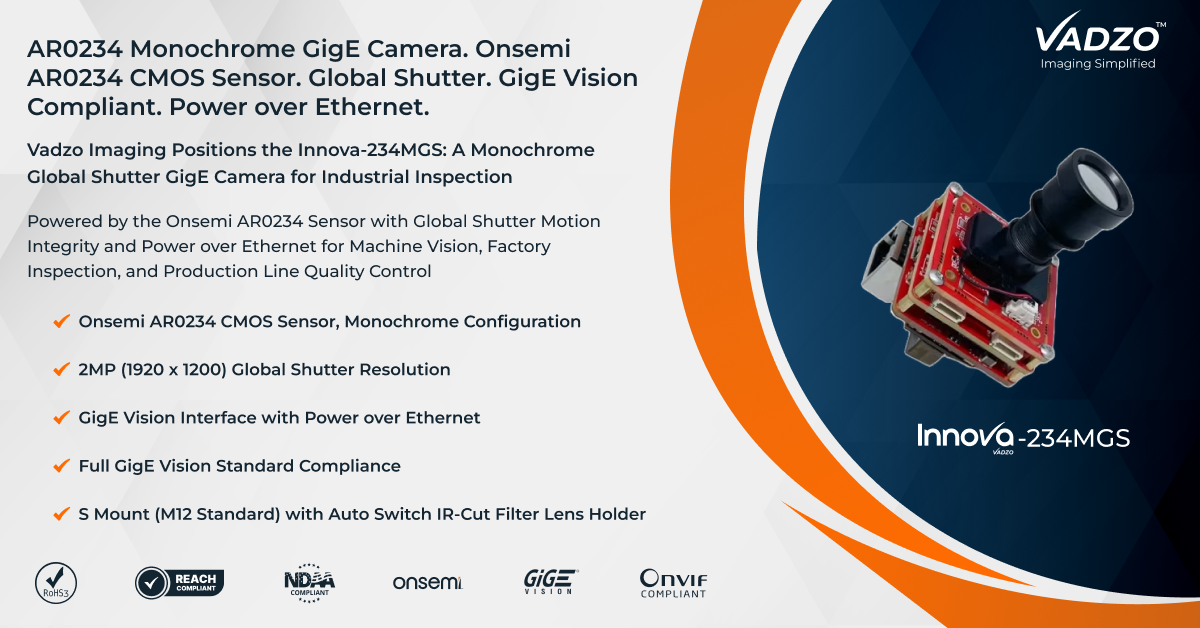
The Innova-234MGS is an AR0234 Monochrome GigE Camera built on the Onsemi AR0234 sensor and positioned specifically for industrial inspection deployments requiring both motion integrity and long cable runs. As a 2MP Global Shutter GigE Camera, it is purpose-built for OEMs who need a camera that solves the motion distortion problem, the contrast problem, and the cable distance problem together rather than accepting a compromise on any one of them. The Onsemi AR0234 Inspection Ethernet Camera designation reflects Vadzo’s positioning of the AR0234 sensor’s monochrome global shutter configuration specifically for factory floor inspection tasks, where color information adds no value and motion distortion directly undermines measurement accuracy. The camera module houses the AR0234 sensor, ISP, and Gigabit Ethernet controller with Power over Ethernet in a compact form factor with a standard S-Mount (M12) lens holder that accepts interchangeable optics for varying working distances and fields of view. The camera presents a standard GigE Vision interface to host software, requiring no proprietary capture card for evaluation or production integration.
Key specs: 2MP (1920 x 1200) | Onsemi AR0234 1/2.6-inch 3.0-micron pixel | Monochrome | Global Shutter | GigE Vision with Power over Ethernet | S-Mount (M12) Optics
Key Capabilities of the Onsemi AR0234 AR0234 Monochrome Ethernet camera
2MP Monochrome Global Shutter Resolution for Inspection: Many inspection camera products force a compromise between motion integrity and cost, since global shutter sensors have historically carried a price premium over rolling shutter alternatives at the same resolution. The Innova-234MGS, positioned as a 2MP Monochrome Gigabit Ethernet Camera, captures a full 2MP (1920 x 1200) monochrome frame with global shutter exposure at a price point suited to fixed-mount inspection deployments rather than only premium machine vision systems. This makes it a genuine 2MP GS Inspection Sensor that OEMs can specify for standard inspection tasks without accepting the resolution or contrast compromises that a lower-cost rolling shutter or color sensor alternative would introduce.
Global Shutter Motion Freeze for Production Line Speed: A rolling shutter sensor reading a frame row by row introduces a timing difference across the image that becomes visible distortion the moment the target moves during capture, and production line speeds routinely exceed the threshold where this distortion becomes measurable. The Innova-234MGS, validated as an AR0234 Inspection GigE Camera, exposes every pixel simultaneously regardless of conveyor speed, eliminating the skew and smear that would otherwise corrupt a dimensional measurement or an edge detection result. This makes the camera a dependable 2MP Ethernet Inspection Camera for assembly line and conveyor-mounted inspection stations where parts pass the camera continuously rather than pausing for capture.
Monochrome Contrast for Defect Detection Without Color Overhead: Color information contributes nothing to most industrial inspection tasks, since surface defect detection, dimensional measurement, and code reading all operate on luminance contrast rather than hue, yet a color sensor’s Bayer filter still absorbs a meaningful share of incident light at every pixel. The Innova-234MGS removes that penalty entirely, delivering a 2MP Mono GigE Inspection capability that resolves finer contrast detail at a given illumination level than a color sensor could provide, and produces a sharper result for a Defect Detection GigE Module tasked with distinguishing scratches, dents, or print defects from the surrounding surface texture.
GigE Vision Interface for Long Production Line Cable Runs: Inspection stations rarely sit within a few meters of the control cabinet or industrial PC running the vision software, and a camera limited to a short cable run forces either a compute module at every station or a costly cabling workaround. The Innova-234MGS removes that constraint through native GigE Vision connectivity with Power over Ethernet, running a single Cat5e or Cat6 cable up to one hundred meters and carrying both data and power over that same run. This makes it a practical Assembly Inspection GigE Sensor for assembly lines that span a large facility footprint, where camera positions are dictated by inspection requirements rather than by how far a shorter interface’s cable could reach. Facility engineers laying out a new line can position each inspection station based purely on the geometry the inspection task requires, without needing to route the line’s mechanical design around the reach of the camera’s interface.
GigE Vision Standard Compliance for Existing Machine Vision Software: Many manufacturing facilities already run GigE Vision compliant software across other inspection lines, and a new camera that does not speak the same standard forces an integrator to either write custom capture code or maintain two separate software stacks side by side. The Innova-234MGS ships as a fully GigE Vision-compliant device, so it integrates directly with the same third-party machine vision software, libraries, and configuration tools an engineering team may already use elsewhere in the facility. This makes a Quality Inspection Gigabit Ethernet camera deployment straightforward to add to an existing line without introducing a new, unfamiliar software dependency for the maintenance and quality teams who will operate it day to day. Standardizing on a GigE Vision-compliant camera across new and existing lines also protects an engineering team’s prior investment in configuration profiles, calibration routines, and operator training built around their existing software, rather than forcing that investment to be duplicated for every new camera vendor added to the facility.
OEM Integration for Industrial Inspection Programs: The Innova-234MGS ships as a complete GigE Vision camera module rather than a bare sensor, giving industrial inspection OEMs a validated starting point instead of an open-ended integration project. Available as a 2MP GS GigE Sensor Kit for evaluation, the camera lets quality engineering teams confirm motion integrity and contrast performance on their own line before committing to a production order. For OEMs evaluating Vadzo as an OEM Inspection GigE Module supplier, this means lens matching, firmware customization, and enclosure design support are available alongside the core camera hardware rather than as a separate engagement. Vadzo’s track record as an Industrial Inspection GigE Camera Supplier and its specific experience as an Industrial Inspection Ethernet Camera Manufacturer cover a production program spanning multiple sensor families and interface types for OEM customers building industrial inspection and quality control products.
“Quality engineers building inspection stations keep telling us the same thing: they need a camera that gets the shape right, gets the contrast right, and can actually reach the camera position their line requires, all at the same time. A camera that only solves one of those problems still fails on the floor, and it usually fails after the line is already running rather than during evaluation. The Innova-234MGS was positioned around solving all three together. By pairing the Onsemi AR0234’s monochrome global shutter architecture with native GigE Vision and Power over Ethernet, we give OEMs a camera that captures a moving part without distortion, delivers the contrast a defect detection algorithm depends on, and runs a hundred meters on one cable while speaking the same GigE Vision standard their existing software already uses.” – Alwin Vincent, Product Manager, Vadzo Imaging.
Application Specific Sections
Industrial Machine Vision Camera Deployments: Machine vision systems evaluating parts for dimensional accuracy or surface quality depend on a camera that renders a moving or stationary part’s true geometry without distortion or color interference. The Innova-234MGS functions as an Industrial Machine Vision Camera for these deployments, delivering global shutter motion integrity and monochrome contrast in a single module that integrates directly with the GigE Vision software a machine vision engineering team already uses across other stations in the facility.
Industrial Inspection Camera Stations: Fixed mount inspection stations positioned along a production line need consistent image quality regardless of exactly where along the line they sit or how far that position is from the control cabinet. The Innova-234MGS serves as an Industrial Inspection Camera for these stations, combining the cable distance advantage of GigE Vision with Power over Ethernet with the motion integrity and contrast that inspection algorithms depend on, giving OEMs a single hardware standard to deploy across every station on a line regardless of position.
Factory Inspection Camera Networks: Factories running multiple inspection points across a large facility footprint benefit from a camera that simplifies both the cabling and the software side of a multi-station deployment. The Innova-234MGS operates as a Factory Inspection Ethernet Camera for these networks, letting facility engineers standardize on a single camera module across every inspection point while running each station over a single Power over Ethernet cable back to a shared network switch rather than provisioning separate power and data infrastructure at each position. Standardizing on one camera module across an entire facility also simplifies spare parts management and technician training, since a maintenance team troubleshooting any station works with the same hardware and the same GigE Vision configuration tools regardless of which line they are servicing.
Production Line Inspection Systems: Production lines that inspect parts continuously as they move need a camera whose motion integrity holds up at whatever line speed the process requires, since slowing the line to accommodate the camera defeats the throughput the automation was meant to provide. The Innova-234MGS functions as a Production Line Inspection GigE Camera for these systems, capturing parts moving at production speed without the skew a rolling shutter sensor would introduce, and its Manufacturing Inspection GigE Sensor suitability extends to lines handling varied part geometries where consistent image quality matters across the full range of products the line produces.
Automated Inspection and Defect Detection Systems: Automated defect detection systems depend on consistent, distortion-free input to reliably distinguish a genuine surface flaw from an artifact introduced by the imaging system itself. The Innova-234MGS serves as an Automated Inspection GigE Camera for these systems, giving automated inspection software a monochrome, global shutter image stream that holds detection accuracy steady across the motion and lighting conditions a production environment actually presents, rather than introducing false positives or false negatives tied to the camera rather than the part. Quality teams tuning a detection algorithm can trust that a flagged defect reflects the part itself, not an artifact the imaging pipeline introduced, which shortens the algorithm tuning cycle since engineers no longer need to separate genuine detection errors from camera-induced ones.
Frequently Asked Questions
Q: Why does Vadzo Imaging recommend a global shutter camera for industrial inspection on moving production lines?
A: Vadzo Imaging designs its inspection camera lineup around how production lines actually operate, where parts move continuously past the inspection point rather than pausing for capture. Vadzo Imaging validates global shutter sensors specifically because a rolling shutter camera introduces geometric distortion on any part in motion, which an inspection algorithm cannot reliably distinguish from a genuine defect. Vadzo Imaging positions global shutter capture as a requirement for accurate inspection at real line speeds, not a premium feature reserved for high-end systems, and validates that requirement under actual line speed conditions rather than a static bench test alone.
Q: Why does Vadzo Imaging use a monochrome sensor instead of color for industrial inspection applications?
A: Vadzo Imaging selects monochrome sensor configurations for inspection camera products because most inspection tasks, including defect detection, dimensional measurement, and code reading, depend entirely on contrast rather than color. Vadzo Imaging’s monochrome camera products remove the color filter layer that a color sensor uses, which increases the light reaching each pixel and sharpens the contrast an inspection algorithm depends on. Vadzo Imaging positions this as a deliberate engineering choice for inspection tasks rather than a lower-cost compromise.
Q: Does Vadzo Imaging’s GigE camera work with existing machine vision software already used on the factory floor?
A: Yes. Vadzo Imaging builds its industrial camera lineup to full GigE Vision compliance, so the camera integrates directly with the same third-party machine vision software, libraries, and configuration tools that a facility may already run on other inspection lines. Vadzo Imaging prioritizes this compatibility specifically so that adding a new inspection station does not require a manufacturing engineering team to adopt a second, unfamiliar software stack.
Q: Can Vadzo Imaging’s inspection camera run long cable distances across a production line?
A: Yes. Vadzo Imaging’s GigE Vision camera lineup uses Power over Ethernet, carrying both power and data over a single Cat5e or Cat6 cable up to one hundred meters. Vadzo Imaging designed this specifically for production line environments, where an inspection station is often positioned well beyond the reach of a shorter-range camera interface from the nearest control cabinet.
Q: Why should manufacturers choose Vadzo Imaging as their industrial inspection camera supplier?
A: Vadzo Imaging offers more than a camera module built around a capable sensor. Manufacturers working with Vadzo Imaging receive engineering support covering lens selection, firmware customization, and enclosure design guidance alongside the core camera hardware. Vadzo Imaging maintains evaluation kits with no minimum order requirement, so quality engineering teams can confirm motion integrity and contrast performance on their own production line before committing to volume production. This combination of validated hardware, standard software compliance, and low minimum evaluation access is why manufacturers continue to choose Vadzo Imaging for industrial inspection camera programs.
Availability
The Innova-234MGS AR0234 Monochrome GigE Camera built on the Onsemi AR0234 sensor is available now for evaluation and production orders. Evaluation kits include the camera module, S-Mount lens, Power over Ethernet injector, and GigE Vision configuration documentation, with no minimum order requirement. Quality engineering teams can confirm motion integrity and contrast performance directly on their own production line before committing to a production bill of materials, which matters more for this camera than a datasheet comparison alone could confirm. Browse the full GigE Vision Inspection Kit lineup at Vadzo’s website or contact Vadzo at support@vadzoimaging.com to request an evaluation unit or discuss OEM integration requirements for industrial inspection, quality control, and factory automation camera programs.
About Vadzo Imaging
Vadzo Imaging is a global provider of embedded vision solutions and delivers high-performance camera technologies and imaging platforms for applications in robotics, industrial automation, UAVs, edge AI, and medical systems. Its products are designed for seamless integration with leading embedded platforms. Vadzo supports customers through hardware customization, firmware development, and module-level drivers, enabling faster development and deployment of vision-based systems across GigE, USB, MIPI, Wi-Fi, and SerDes camera interfaces.
Media Contact
Alwin Vincent
Vadzo Imaging
Email: alwin@vadzoimaging.com
LinkedIn: Vadzo Imaging
YouTube: Vadzo Imaging
X: Vadzo Imaging
SOURCE: Vadzo Imaging
View the original press release on ACCESS Newswire
Media gallery